
The Convenience Trap
We have spent thirty years making shopping easier to complete and harder to enjoy.
The logic was reasonable enough at the time. Remove friction, increase conversion. Optimise the funnel. Get the customer from intent to checkout before they change their mind. And it worked, spectacularly, for a while. Online retail in the UK grew from a niche novelty to the highest penetration rate in Europe, representing 27.5% of annual retail sales (ONS, 2026). Warehouses replaced windows. Algorithms replaced shop assistants. The mission was accomplished.
The problem is what we were optimising for: 'Mission shopping' — the transactional, purposeful, joyless extraction of a product from a supply chain, and it became the dominant model of retail consumption. Not browsing. Not discovering. Not the half-hour in a bookshop that sends you home with three things you didn't know you needed. The mission. In, out, unboxed, reviewed, potentially returned.
The unboxing moment becomes the apex of this model: a performance of acquisition, no longer the fun conversation with the person who sold it to you, the chance encounter with something adjacent on the shelf, the simple pleasure of being somewhere that isn't your sofa.
Returns are the material consequence of this hollowing out. When products are bought without genuine engagement, rushed through a conversion funnel designed to discourage hesitation, the mismatch between expectation and reality is built in. UK retail returns cost an estimated £25.1 billion annually for non-food items alone (Retail Economics / ZigZag, 2025). That figure is not a logistics problem. It's a relationship problem. Fixing the relationship at the product level — honest visual representation, accurate material data, genuine product information — addresses a key aspect of the returns cost at source, before the parcel is packed.
The main fix beyond product is reinvigorating relationships of trust between consumers and retailers:
"If we just say bricks-and-mortar retail is about more bloody stuff — give me a break, you ain't gonna be here. How do we create these new destinations, these new anchors that are no longer just about stuff and product?"
— Mary Portas, Campaign Live, 2019
The question Portas posed then is the question the industry is finally being forced to answer now — not by introspection, but by technology.
When the 'Aigent' Arrives
The publishing industry noticed the shift first and loudest. When Google introduced AI Overviews in 2024, synthesising content from across the web to answer queries directly on the search results page, publishers lost referral traffic at rates that ranged from uncomfortable to catastrophic. Analysis by Chartbeat showed Google traffic to publishers globally down by a third year-on-year, comparing 2024 to 2025 (Reuters Institute, 2026). The model that had worked for thirty years — create content, receive traffic — stopped working.
Retail has been slower to join the conversation. It shouldn't be.
What happened to publishers is a structural preview of what is happening now to product discovery. The mechanism is the same; the commercial stakes for retail are, if anything, higher.
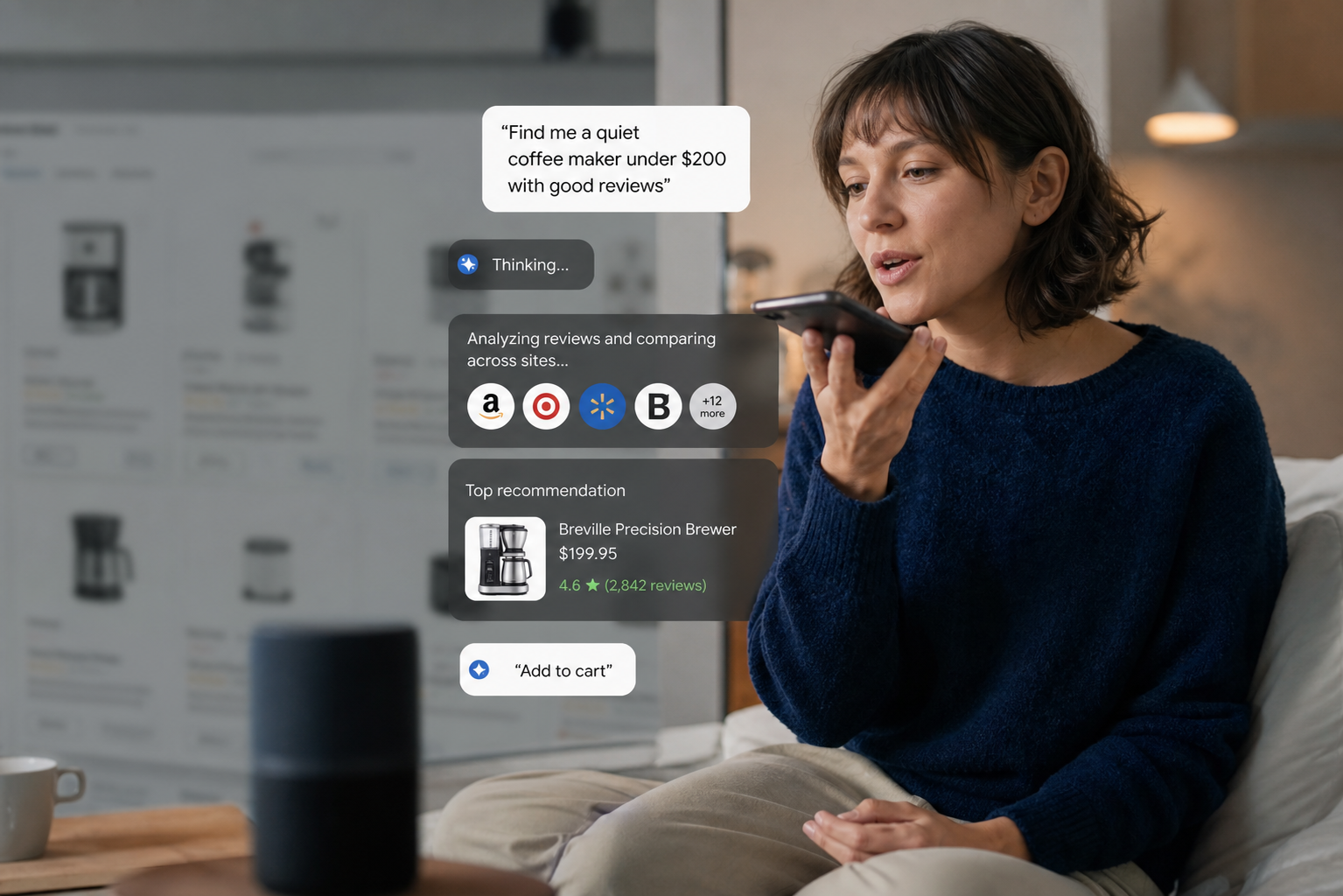
The agentic purchase journey, in brief: A customer wants a new washing machine. They no longer open a browser, navigate to a retailer's homepage, filter by spin speed and energy rating, read three reviews, abandon the basket, return the next day and complete the checkout. Instead, they speak to an AI agent. The agent queries structured product data across multiple sources, applies the customer's known preferences — energy efficiency, budget, delivery window, sustainability credentials — and surfaces a recommendation. The transaction may complete without the customer visiting a single retail website. Their first and only touchpoint with brands may be a line of text in an AI-generated summary, attributed or not.
This is not science fiction. It is the logical continuation of consumer behaviour that has been trending in this direction since voice search, since comparison engines, since the first time a customer asked Alexa to add something to their basket.
The uncomfortable questions this raises for retailers are not hypothetical:
Who owns the product data the agent is querying? In a supply chain involving manufacturer, wholesaler, and retailer, product data has historically been inconsistent, duplicated, and siloed at every layer. An AI agent querying that chain does not gracefully resolve the inconsistencies — it either gets a confident wrong answer, or it skips your product entirely in favour of a competitor whose data is cleaner. The brands investing in structured, machine-readable, sustainability-enriched product information now are not doing compliance work. They are doing discovery infrastructure.
What does your digital estate look like when the customer's first touch is an AI summary, not a homepage? The website you have spent years optimising — the navigation, the imagery, the conversion flow — may not be the place where your brand is encountered at all. Your result page and your website are no longer the same thing. The question is not how to optimise the homepage. The question is whether your product information is structured well enough to be pulled into the agent's answer at all, and whether, when it is, there is enough of your brand in that data to create a relationship, not just a transaction.
And what happens when your product content informs the agent's recommendation without credit, without a link, without a visit? The publishing industry has been grappling with this as an existential question for two years. For retail, it is arriving with less noise but equal force. Content — product content, visual content, specification data — is the raw material that AI agents consume. The question of who benefits from that consumption, and on what terms, is seemingly unresolved. The brands that wait for the terms to be settled before acting on the infrastructure will be late.

The High Street's Unlikely Second Wind
Here is where the retail narrative diverges, productively, from the publishing panic.
Publishers losing search traffic have lost something genuinely hard to recover: discovery by strangers who would never have found them otherwise. A reader who arrived via Google and never returned is not a relationship; it's a visit. Losing visits at scale is damaging.
Retailers losing agentic discovery face a different structural condition because the agent's goal is not to answer a query abstractly. It's to complete a customer's want in the real world with physical presence.
An AI agent that understands a customer's location, their preference for immediate collection over next-day delivery, and the environmental cost of a delivery van making a five-mile journey, will check local inventory and surface the stockist two streets away who has the product in stock today. That is not a threat to physical retail. It is, potentially, the most effective footfall driver the high street has seen in a decade.
The footfall that online convenience stripped from high streets over thirty years was, largely, mission footfall — the purposeful acquisition trips that moved online because online was faster and cheaper. Agentic shopping routes mission footfall more intelligently. The customer arrives at your door because the agent told them you have what they need, nearby, now.
And then it's game on.
Because the customer who arrives having been sent by an agent is a customer with intent and proximity. They are not browsing aimlessly. They are not comparison-shopping. They are there. What happens next is entirely in your hands and it has nothing to do with algorithms.
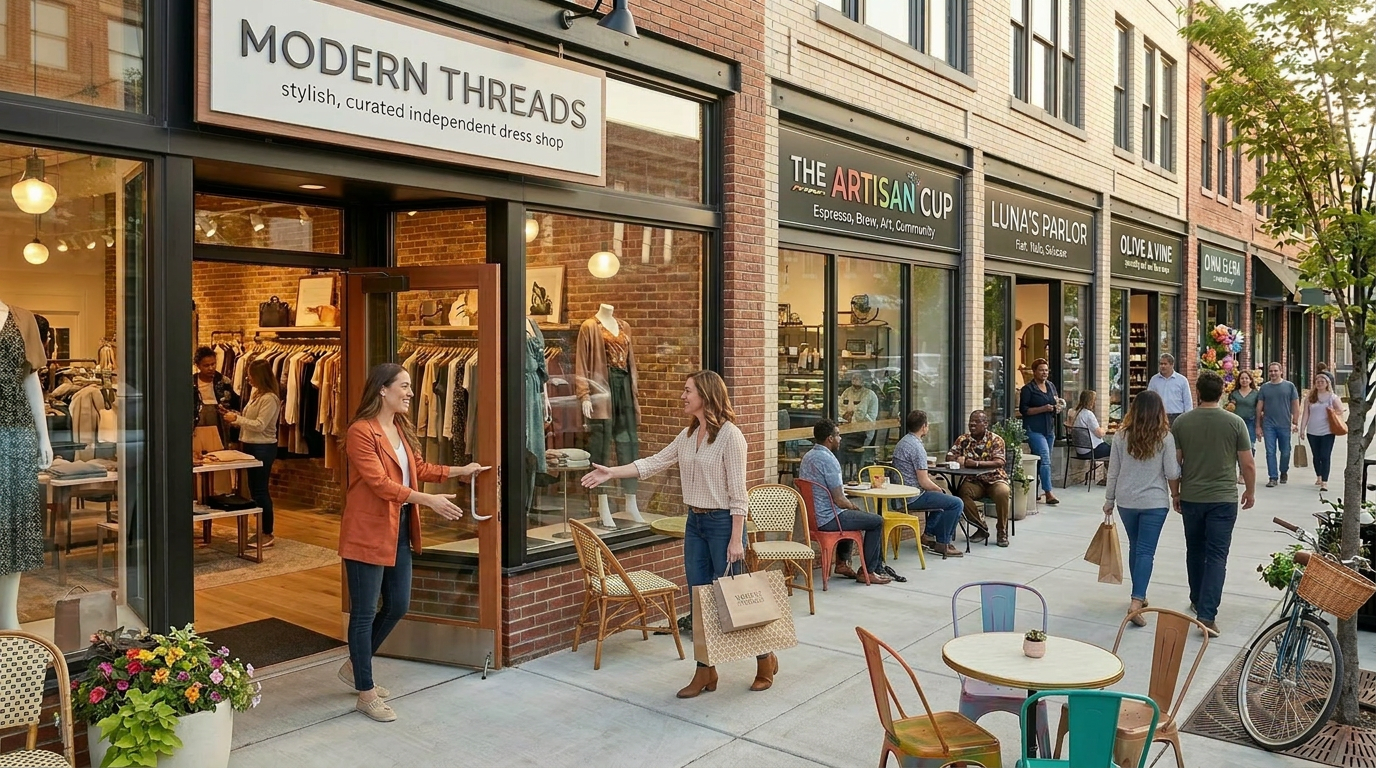
This is the space where the window dresser flexes their creative muscles again. Where the shop assistant who actually knows the product range becomes a differentiator, not a cost centre. Where a retailer who has invested in their physical environment — in hospitality, in event programming, in the kind of joined-up local experience that an adjacent shop or a nearby venue can amplify — finds that the agent has done the hard work of getting the customer through the door, and they get to do the interesting work of making them want to come back.
This requires something the retail industry has not been brilliant at: collaboration. Joined-up experiences across a market — offers, events, and promotions that cross the boundaries of individual retailers to create something genuinely worth the visit. These require a willingness to treat adjacent businesses as partners rather than competitors. A new type of convenience emerges: not a transaction completed invisibly, but a destination worth the investment of a customer's time, money, and the increasingly scarce resource of human attention.
Trust is Demonstrating Shared Values
The online-only retailer faces a different version of this challenge. There is no high street footfall to redirect, no window to dress, no community to anchor. The model is perpetual newness, a 24/7/365 obligation to refresh the feed, restock the range, and surface the next thing before the customer looks elsewhere. For hybrid retailers operating both physical and digital estates, the tension is acute: digital demands velocity; physical demands depth. Neither fully satisfies either.
Beneath both of these pressures sits the same unresolved question: why should customers trust us?
The evidence suggests the problem is real and worsening. UK consumer confidence reached its lowest level since Q3 2023 in Q1 2026, with discretionary spending falling to a three-year low (Deloitte Consumer Tracker, Q1 2026). This is not merely macroeconomic — it is relational. Consumers are not only tightening their spending; they are becoming more discriminating about where it goes.
The answer to the trust question is not a brand promise or a sustainability report published annually in a PDF that nobody reads. It is demonstrated — through every product interaction, through the accuracy of the information a customer receives before they buy, through the honesty of the visual representation that sets their expectations, and through the consistency of the experience when they arrive, online or in store.
This is where the practice of seven-generation thinking becomes useful. The indigenous principle — that decisions should be made with consideration of their impact seven generations forward — is not a romantic abstraction. Applied to retail, it is a provocation: are you promoting products that we value, maintain, repair and pass on? Are you building a customer relationship designed to last one transaction, one season, one campaign cycle? Or are you building something that delivers returning customers for a lifetime?
The brands that are getting this right are not asking customers to change their values in order to do business with them. They are embedding those values into the product itself. Deloitte's 2025 Sustainable Consumer research shows that consumers increasingly believe businesses must make sustainable options accessible and affordable — adoption of sustainable behaviours has plateaued and cost barriers have risen (Deloitte UK, 2025). The burden of sustainable consumption has been placed on the supply side, and there are many unexpected rewards.
Product 125 is built on exactly this understanding. Every aspect of our digital services — from the 3D asset pipeline through to the Fleet Suite infrastructure that runs it — works to embed long-term sustainable practice into margin-growing business. Not as a constraint on commercial performance, but as the architecture of it. The visual and 3D work we do integrates customers' aspirations and needs with the material reality of what a well-considered product is, how it was made, and how long it is designed to last. When you can show a product honestly, in photorealistic 3D, in movies, in the customer's actual space, at the correct scale, you are not just reducing returns. You are building the foundation of a relationship that has a chance of lasting.

The Regulations We Will Be Grateful For
There is a reliable test for whether a regulatory change represents genuine progress: wait twenty years, then notice whether anyone is arguing to reverse it.
When was the last time you noticed the plastic bag you weren't given? When did you last reach for a straw that wasn't there, resent the LED bulb that doesn't make you squint, or think about the kids breathing in lead from car exhaust pipes? The regulations that reshaped those defaults were contested loudly at the time and are now invisible, absorbed into the normal fabric of how we live.
The incoming wave of product regulation — the EU's Ecodesign for Sustainable Products Regulation (ESPR), the Digital Product Passport (DPP) requirements enforced from 2027, extended producer responsibility frameworks, repairability scoring — will follow the same arc to becoming normal. The retailers who treat them as an invitation rather than an imposition will have built, by the time normalisation arrives, a structural advantage that their competitors spent the same period resisting.
The Digital Product Passport is the most tangible expression of this shift for retail. By requiring a machine-readable, persistently accessible record of a product's material composition, energy consumption, repairability, and end-of-life pathway, it creates — as a compliance obligation — exactly the structured product data that AI agents prefer to query, that sustainability-conscious consumers want to access, and that supply chain partners need to make sourcing decisions. The compliance cost and the commercial opportunity are the same infrastructure investment.
The British public understands this, even if the retail industry has been slow to follow. Despite recent softening in some climate attitudes, UK Government and ONS data consistently shows that 77–80% of British adults remain concerned about climate change (ONS, 2025; DESNZ, 2025). Sixty percent support the UK's net zero target, with backing holding across Conservative as well as Labour and Liberal Democrat voters (YouGov, 2025). The perception that climate concern is a niche or partisan position is a media artefact, not a reality.
This is what seven-generation thinking looks like as a commercial strategy. Not the sacrifice of near-term margin for distant-future virtue. The recognition that the businesses still standing in thirty years will be the ones that, in 2026, started building customer relationships durable enough to survive every algorithm change, every search engine disruption, every AI agent transition that comes next.
"The retailers planting roots right now in their communities are the ones who'll still be standing in ten years. The ones still asking how cheap, how fast, how much can we squeeze out, are running a different race entirely."
— Mary Portas, BRC Leaders Summer School, May 2026
The soul of retail was never the transaction. It was always what the transaction made possible: the relationship, the community, the sense of being somewhere that knew you and wanted you to come back.
AI agents will handle more of the logistics. The question for UK retail is not whether to resist that, but what to do with the space it creates. The answer, for the retailers who get this right, is the same thing it has always been and what it was before convenience became the only virtue we measured.
Let's build the place people want to spend their time. Earn the trust that brings them back. Make something worth seven generations of investment.
References
British Retail Consortium (2026) 'Mary Portas to open BRC Leaders Summer School', Retail Technology Innovation Hub, 30 April.
Climate Barometer (2025) New public polling: Behind the noise on net zero.
Deloitte UK (2026) Cost and sustainability fatigue stifle consumers' efforts to adopt more sustainable lifestyles. The Sustainable Consumer.
Office for National Statistics (May 2026) RSI: Internet: All Retailing excl auto fuel: All Bus: SA: proportion of retail.
Deloitte UK (2026) The Deloitte Consumer Tracker, Q1 2026.
Houston, P. (2026) The Zero-Click Content Shift. MediaVoices / WoodWing.
Office for National Statistics (2025) Public opinions and social trends, Great Britain: October 2025.
Portas, M. (2019) Interview, Campaign Live, December.
Retail Economics / ZigZag (2025) ZigZag returns benchmark 2025 — Lessons from 100 online returns.
Reuters Institute (2026) Journalism and Technology Trends and Predictions 2026.
YouGov (2025) 'How far does the public support net zero?', November.
About the Authors
Kat Graham is Founder and Enterprise Architect at Scout & Swan, an AWS Technical Partner. A UK IT Awards winner and hyper-agile delivery leader, she has designed, built and run digital services for the BBC, Channel 4, the Financial Times, ASOS, British Airways, the UK Home Office, and Next plc. A Carbon13 C6 founder and Cambridge Institute for Sustainability Leadership graduate, Kat founded Scout & Swan to apply cloud infrastructure rigour, visual commerce technology, and a genuinely long view to the problems retail needs to solve next.
Christopher Imrie is a Principal Engineer and technical leader. Formerly Director of Engineering at Torque Brands and Principal Engineer at Mindera, he has led composable commerce transformations at scale with Burberry, Selfridges, M&S, and B&Q.
Kat and Christopher met at the Financial Times, where they worked as Data and Engineering principals on machine learning and AI for a novel private equity service.